

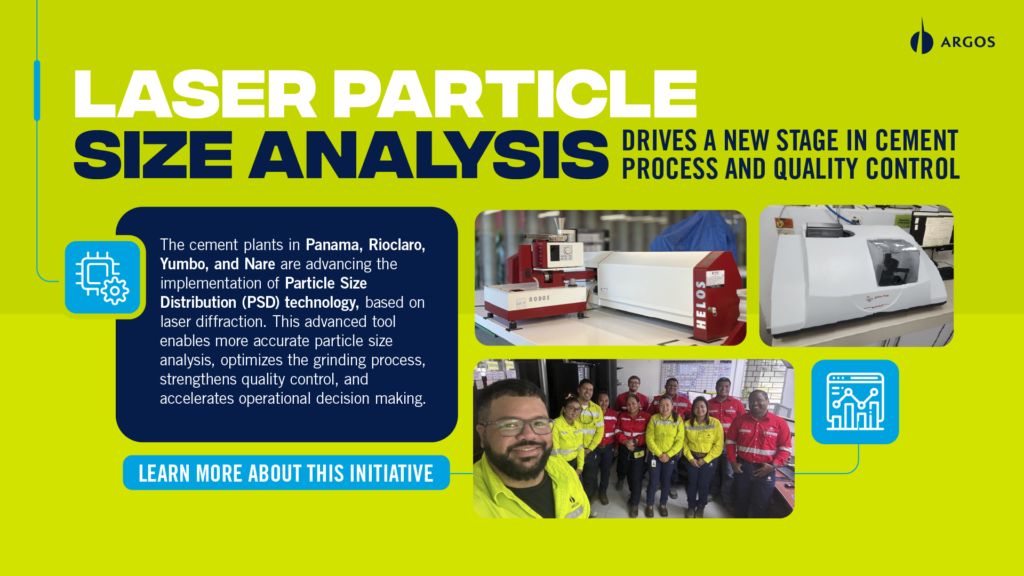
As part of our ongoing commitment to operational excellence and technological leadership, our cement plants in Panama, Rioclaro, Yumbo, and Nare are advancing the implementation of Particle Size Distribution (PSD) analysis using laser diffraction, an advanced technique that is transforming the way we understand and control the particle size of our products.
Unlike the traditional 325 mesh residue test, which provides a single isolated value without revealing how particles are distributed or where they are concentrated, laser particle size analysis delivers a comprehensive characterization of the entire particle population from the finest particles to the medium and coarse fractions.
This level of detail provides valuable business insights by enabling us to:
- Predict cement performance: Better understand the factors behind increases or decreases in early- and late-age compressive strength.
- Optimize setting behavior: Analyze the physical variables and water demand that influence the acceleration or delay of setting times.
- Evaluate grinding efficiency: Gain a deeper understanding of separator and mill performance, making PSD a comprehensive diagnostic tool for both the finished product and the grinding system.
A Web Application for Faster Decision-Making
The Particle Size Distribution (PSD) Analyzer is a single-page web application (SPA) developed specifically for Argos laboratories. It enables users to upload, visualize, compare, and report particle size measurements for cement and clinker from analytical instruments manufactured by different suppliers all without installing any software, as it runs directly in a web browser.
The success of this implementation lies not only in the testing methodology itself, but also in the digital transformation of its results. Through close collaboration with the Digital & Analytics Laboratory, we have achieved:
- Time savings: Automatic extraction of key parameters by eliminating manual data transcription.
- Traceability: A complete history of measurements, including dates, operators, and equipment used.
- Standardization: Consistent alert criteria across all laboratory instruments.
- Portability: No software installation required; accessible from any computer using Chrome or Microsoft Edge.
- Data security: 100% local processing with no data uploaded to external servers.
- Multi-instrument compatibility: Consolidation of results from four different analytical platforms into a single interface.
This collaboration enables the automatic generation of particle size distribution curves and the immediate calculation of key control parameters (D10, D50, and D90). By digitizing and automating data processing, the team significantly reduces analysis time, accelerates decision-making, and enables timely adjustments to both material design and production process variables.
This joint effort between our cement plants and the Future Tech and Digital & Analytics laboratories reinforces the critical role of research and development, advanced analytics, and artificial intelligence in building the future of our industry.