

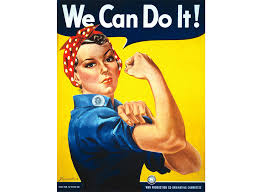
Earlier this month, we celebrated International women’s day on March 8. This was only part of the much large celebration of Women’s History. To continue our celebration, we are looking at the history of women in the field of construction.
At the start of World War II, most Americans still held an old-fashioned notion of women’s place in society. It was common to believe that women had no ability to do mechanical or technical jobs and were perceived to be physically incapable of heavy labor. But while thousands of men were serving our country, women found new job opportunities in factories and shipyards. By 1943 hundreds of thousands of women worked in shipyards across the country, doing work traditionally reserved for men. Women operated huge cranes that moved entire ships into place for final assembly, and thousands worked as riveters and welders in the war plants. Westinghouse Electric even trained dozens of women in electrical engineering due to the shortage of male workers.
Many laws and amendments have been passed over the years to protect and encourage women in the workforce. The Civil Rights Act of 1964, affirmative action in 1965, and two amendments to prohibit gender discrimination and work hours of women followed two years later. Although still less than 3% of the national construction workforce and just 4% of CEO positions at America’s 500 largest companies, women are drawn to the love and challenge of their profession, including seeking the economic security of high-paying jobs. While women on construction sites still face some sexism and disrespect, this type of behavior is becoming less prevalent, and women are now, on the whole, accepted as valued tradespeople.
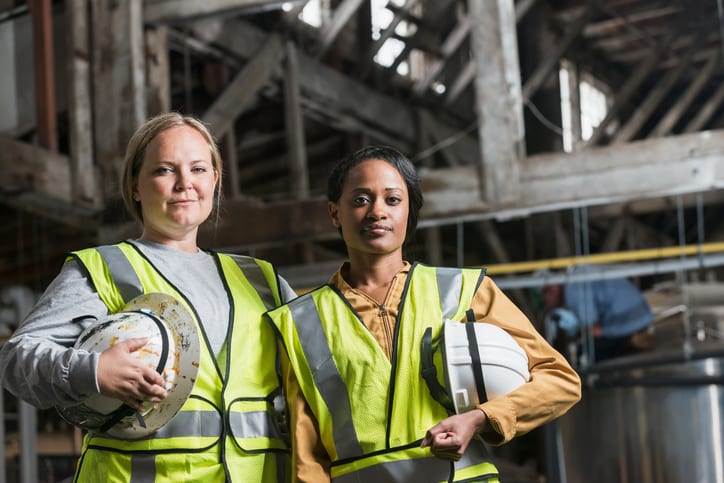
One of the first documented women in construction was in the late 1800s. Emily Roebling stepped in as the «first woman field engineer» and saw out the completion of the Brooklyn Bridge but only because her husband had become ill. The Brooklyn Bridge opened on May 24, 1883, and Emily was the first to cross it. Louise Blanchard Bethune was the first American woman who is acknowledged to have worked as a professional architect. Born in 1856, she lived and worked primarily in Buffalo, New York, where she partnered with her husband at Bethune, Bethune & Fuchs. In 1926 Lillian Gilbreth graduated as an industrial engineer and was accepted into the American Society of Mechanical Engineers, and was the first honorary member of the Society of Women Engineers.
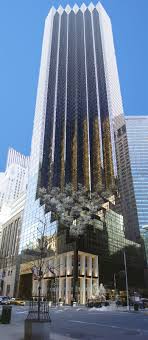
It wasn’t until 1979 that Barbara Res was placed in charge of the Trump Tower construction, making her the first female hard-hat boss to ever oversee an American skyscraper from start to finish.
If you would like to learn more about women’s history in construction, follow the link below to find a full-length feature documentary about women, some of the first female ironworkers and electricians, plumbers and pile drivers, boilermakers, and masons.
At Argos, we are proud to celebrate how far women have come in our field and are dedicated to promoting equal opportunity employment for people of all genders. We have come so far, but let’s continue to go even farther!
«The History of Women in the Construction Industry, and How Far They Have Come – By Annie McEvoy.» NEREJ, nerej.com/the-history-of-women-in-the-construction-industry-and-how-far-they-have-come-by-annie-mcevoy