

Daylight Savings Time is Sunday, March 14th! Don’t forget to spring forward an hour. Whether you are glad to have an extra hour of sunshine or dreading losing an hour of sleep, Daylight Savings is an interesting tradition with a fascinating history.
- BENJAMIN FRANKLIN WAS HALF-JOKING WHEN HE SUGGESTED DAYLIGHT SAVING TIME.
A century before Daylight Saving Time (DST) was adopted by any major country; Benjamin Franklin proposed a similar concept in a satirical essay. In the piece, published in 1784, he argued:
«All the difficulty will be in the first two or three days; after which the reformation will be as natural and easy as the present irregularity […] Oblige a man to rise at four in the morning, and it is more than probable he will go willingly to bed at eight in the evening; and, having had eight hours sleep, he will rise more willingly at four in the morning following.»
- OFFICIAL CREDIT FOR THE DAYLIGHT SAVING TIME IDEA GOES TO A BUG COLLECTOR.
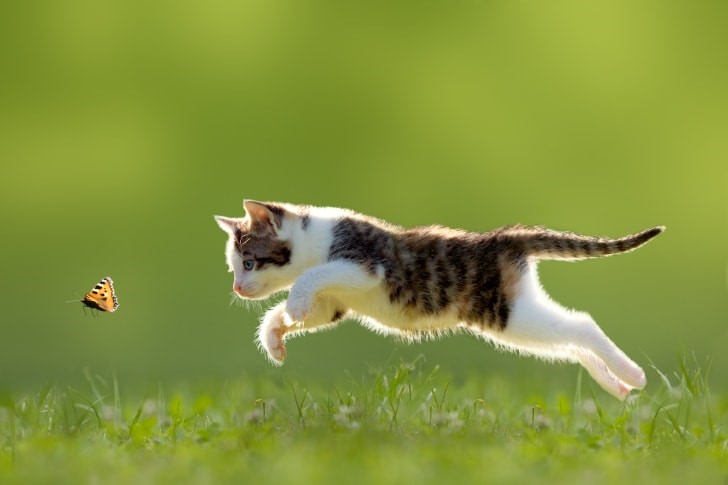
Like the entomologist, this kitten enjoys springing forward in pursuit of insects.
The first serious case for DST came from a peculiar place. While working at a post office by day, an entomologist who did most of his bug hunting at night soon became frustrated by how early the sunset during the summer months. He reasoned springing the clocks forward would allow more daylight for bug collecting—along with other evening activities. The clocks could be switched back in the winter when people (and bugs) were less likely to be found outdoors.
When the idea was proposed to a scientific society in New Zealand in 1895, it was panned for being pointless and overly complicated. Just two decades later, Daylight Saving Time would begin its spread across the developed world.
- WORLD WAR I PUSHED DAYLIGHT SAVING TIME INTO LAW.
In 1916, Germany became the first country to adopt Daylight Saving Time officially. It was born out of an effort to conserve coal during World War I, and Britain, along with many other European nations, was quick to follow the Germans’ lead. It wasn’t until 1918 that the time change spread to the U.S. A year after entering the war, America began practicing DST as an electricity-saving measure. Most countries, including the U.S., ceased official observation of the switch following wartime.
- DAYLIGHT SAVING TIME GAINED RENEWED POPULARITY DURING THE ENERGY CRISIS.
The U.S. reconsidered DST in the 1970s, when, once again, the argument pivoted back to energy conservation. The oil embargo of 1973 had kicked off a nationwide energy crisis, and the government was looking for ways to reduce public consumption. Daylight Saving Time was imposed at the beginning of 1974 to save energy in the winter months. Not everyone was enthusiastic about the change: Some of the harshest critics were parents suddenly forced to send their children to school before sunrise.
- DAYLIGHT SAVING TIME MAY ACTUALLY BE AN ENERGY WASTER.
Despite Daylight Saving Time’s origins as an energy-saving strategy, research suggests it might be hurting the cause. One 2008 study conducted in Indiana found the statewide implementation of DST two years earlier had boosted overall energy consumption by 1 percent. While it’s true that changing the clocks can save residents money on lighting, the cost of heating and air conditioning tends to go up. That extra hour of daylight is only beneficial when people are willing to go outside to enjoy it.
- DAYLIGHT SAVING TIME IS ALSO A HEALTH HAZARD.
Despite Daylight Saving Time’s origins as an energy-saving strategy, research suggests it might be hurting the cause. One 2008 study conducted in Indiana found the statewide implementation of DST two years earlier had boosted overall energy consumption by 1 percent. While it’s true that changing the clocks can save residents money on lighting, the cost of heating and air conditioning tends to go up. That extra hour of daylight is only beneficial when people are willing to go outside to enjoy it.
- DAYLIGHT SAVING TIME IS ALSO A HEALTH HAZARD.

Losing an extra hour of sleep can take a ruff physical toll.
Even if daylight savings is suitable for your energy bill, that doesn’t negate its adverse impact on human health. Numerous studies show the extra hour of sleep we lose by springing ahead can affect us in dangerous ways. An increased risk of heart attack, stroke, susceptibility to illness, and seasonal depression have all been linked to the time change.
- BUT THERE ARE SOME BENEFITS TO DAYLIGHT SAVING TIME.
Though people love to complain about it, Daylight Saving Time isn’t all bad news. One notable benefit of the change is a decrease in crime. One study published in 2015 found that DST’s start in the spring was associated with a drop in robberies.
- DAYLIGHT SAVING TIME IS NOT OBSERVED NATIONWIDE.
DST has been widely accepted across the country, but it’s still not mandated by federal law. U.S. residents resistant to springing forward and falling back each year might consider moving to Arizona. The state isn’t exactly desperate for extra sunlight, so they skip the time jump every spring. This leaves the Navajo Nation, which does observe the change, in a peculiar situation. The reservation is wholly located within Arizona, and the smaller Hopi reservation is fully located within the Navajo Nation. The Hopi ignore DST like the rest of Arizona, making the Navajo Nation a Daylight Saving donut of sorts, suspended one hour in the future for half the year.
- DAYLIGHT SAVING TIME STARTS AT 2 a.m. FOR A REASON.

No time disruption worries or schedule snafus here!
Daylight Saving Time doesn’t begin at the stroke of midnight like you might expect it to. Instead, the time change is delayed until most people (hopefully) aren’t awake to notice it. By waiting until 2 a.m. to give or take an hour, the idea is that most workers with early shifts will still be in bed, and most bars and restaurants will already be closed.
- THE CANDY INDUSTRY LOBBIED FOR AN EXTENSION OF DAYLIGHT SAVING TIME.
Until recently, losing an hour of daylight in the fall presented a problem for the candy industry. That’s because Daylight Saving Time traditionally ended on the last Sunday in October, a.k.a. before Halloween night. Intense lobbying to push back the date went on for decades. According to one report, candy lobbyists even went so far as to place tiny candy pumpkins on everyone’s seats in the Senate in 1985. A law extending DST into November finally went into effect in 2007.
“Daylight Savings.” Mental Floss, 1 Mar. 2021, www.mentalfloss.com/article/642926/amazon-launchpad-page-small-business?utm_content=infinitescroll1