


Picking the right Objectives
Picking the right Objectives is harder than you might think. Setting the right Objective at the right time is even more difficult.
Types of Objectives
Although it sounds like a no-brainer, it’s not always clear to teams brainstorming their Objectives what an Objective can be used for.
To get more clarity on this, you should first understand that an Objective is always designed to get you out of your status quo. That means that if you’re completely satisfied with how things are going at the moment, you may not have the need for an Objective.
When you’d like to move forward and get out of your status quo, there are 3 different types of Objectives you can use:
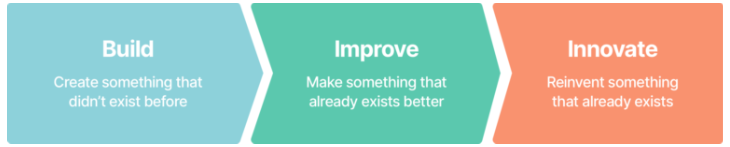
Typically, these 3 types of Objectives are used in the order they are displayed above. For example, you can’t improve something that hasn’t been built yet.
Let’s have a closer look at these 3 different types of Objectives.
Build
A build Objective creates things that didn’t exist before.
Improve
Everything that you do to make something better that already exists, falls into the category of an Improve Objective. You can improve for different reasons, such as to improve the quality or performance of something or to deliver the same quality or performance at a lower cost.
Innovate
Sometimes improvement isn’t enough, and something more drastic is required: innovation. You can innovate your product, parts of your product, and even your organization’s management (e.g. by introducing OKRs).
Tips For Choosing The Right Objectives

Close and review OKRs from previous timeframe
Always review your OKRs when the time frame is about to end. This exercise will tell you whether you need to port over any OKRs to the following time frame, significantly impacting your available bandwidth for the future.
Check the purpose of your team
Why have you been hired? What’s the purpose of your team and your position? Are you living up to these expectations? The Objectives that you’ve set for yourself, are they in-line with what is expected of you?
Crowdsource the knowledge of your people
In the Industrial Age, the manager was often seen as the person who knew everything and was best equipped to make decisions. Those days are over. It’s the people closer to the ball who have unique insights into what’s going on, either within the business or in the market. Use this knowledge!
With modern tools, it’s easy to collect input. Ask your team to suggest 1 or 2 Objectives for the upcoming period. Discuss the most popular suggestions with management and try to make at least one of them a company or team-level Objective.